
HomePlantBot care guide
Do Snake Plants Purify Air? What the Research Shows
Explore what research really says about snake plants and indoor air quality, including the limits of laboratory studies and realistic benefits at home.
Do snake plants purify indoor air?
Not enough to meaningfully clean the air in a typical home. Snake plants can absorb some volatile organic compounds in sealed laboratory chambers, but normal rooms exchange air, contain much more air volume, and expose plants to changing light and airflow. A few pots should not be treated as an air purifier.
Keep a snake plant because it is attractive, durable, and easy to fit into a care routine—not as a replacement for ventilation, source control, or a properly selected air cleaner.
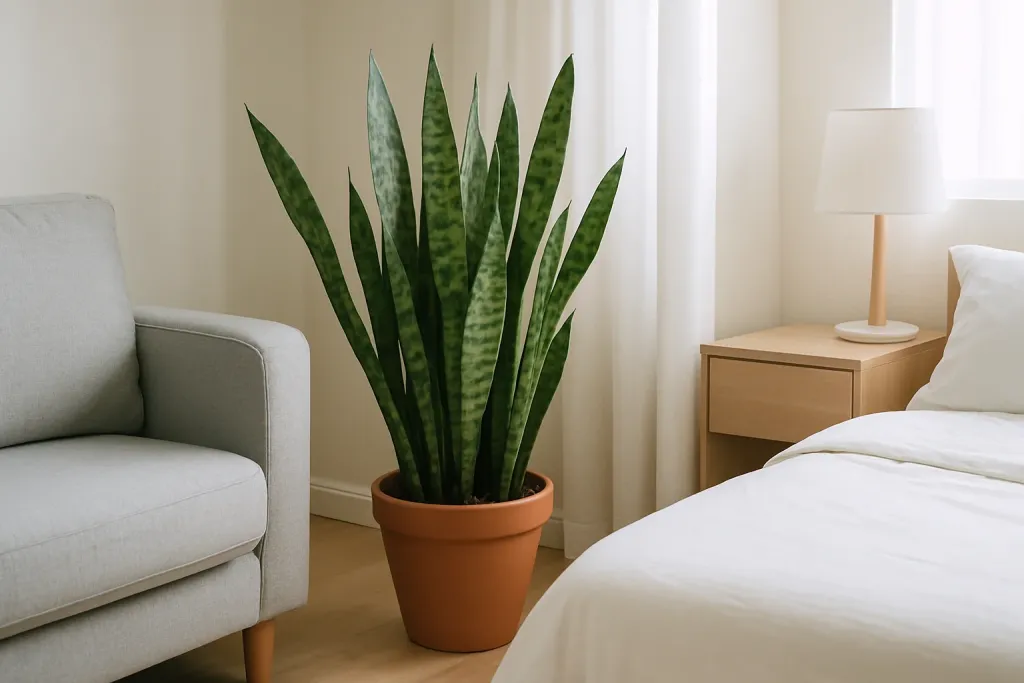
Why the air-purifying claim became popular
A widely shared NASA study tested plants and growing media inside small, sealed chambers. Some plant-and-soil systems reduced selected chemicals under those controlled conditions. The experiment was useful for studying closed environments, but it did not show that one or two plants can clean an occupied bedroom or office.
The original chamber research is available through the NASA Technical Reports Server. The important distinction is scale: detecting chemical removal in a sealed chamber is not the same as producing a meaningful clean-air delivery rate in a real building.
What later research found
Cummings and Waring’s review (published online in 2019 and in a 2020 journal issue) converted results from 12 studies into a clean-air delivery rate that could be compared with ordinary building ventilation. Across the reviewed chamber results, passive potted plants removed volatile organic compounds far too slowly to compete with typical building air exchange. Their modeled range was 10–1,000 plants per square meter of floor space to match roughly one air change per hour. This is a cross-study estimate, not a tested snake-plant prescription for a bedroom.
You can read the review in the journal Journal of Exposure Science & Environmental Epidemiology. The PubMed abstract summarizes the methods and estimates. The household claim extends well beyond what chamber measurements establish.
What snake plants can—and cannot—do
| Claim | Realistic takeaway |
|---|---|
| Removes VOCs | Measurable in some controlled chambers, but too slow at household scale to replace ventilation. |
| Produces oxygen at night | CAM plants can take up carbon dioxide at night. Oxygen production requires light; CAM does not mean a plant releases oxygen all night. |
| Prevents mold | No. Overwatered soil can support mold; manage moisture and fix the building source. |
| Improves well-being | Plants may make a room feel calmer or more inviting, but that is different from filtering pollutants. |
What actually improves indoor air
- Control the source. Store solvents securely, avoid smoking indoors, run exhaust fans while cooking, and address water damage or mold at its source.
- Ventilate when outdoor conditions allow. Use a working range hood and bathroom exhaust, and follow local guidance during wildfire smoke or high-pollution events.
- Use the right filtration. A correctly sized HEPA air cleaner targets particles. Activated carbon can help with some gases and odors, but capacity and replacement intervals matter.
- Maintain HVAC filters. Choose a filter your system can handle and replace it on schedule.
For smoke, carbon monoxide, gas leaks, or suspected toxic exposure, do not rely on plants. Leave the area when appropriate and follow emergency or public-health guidance.
Why a snake plant can still be a good houseplant
Snake plants tolerate missed waterings, fit narrow spaces, and can remain presentable in a range of indoor light. They can also encourage routines—checking soil, opening blinds, or noticing room conditions—that make a space feel more cared for. Those are worthwhile benefits even though they are not air filtration.
For healthier growth, give the plant bright indirect light when possible, use a fast-draining mix, and let much of the pot dry before watering. Our snake plant grow-light guide explains lighting, while the soil and pot guide covers root-zone care.
Bottom line
Snake plants participate in plant chemistry, but a handful of them will not purify the air in a normal home at a meaningful rate. Use ventilation, source control, and suitable filtration for air-quality problems. Grow snake plants for their appearance and forgiving care instead.
Frequently asked questions
How many snake plants would it take to purify a room?
There is no practical household number. Research comparing chamber studies with building ventilation found that very large quantities of plants would be needed to approach ordinary air-exchange rates.
Should I put a snake plant in my bedroom for oxygen?
You can keep one there if the light and temperature suit it, but it is not an oxygen treatment. Nighttime carbon-dioxide uptake in CAM plants is not the same as nighttime oxygen production.
Is a snake plant a substitute for an air purifier?
No. Use an appropriately sized air cleaner for particles and ventilation or source control for pollutants. A snake plant is decorative, not an air-cleaning appliance.
Sources and further reading
- NASA: controlled-chamber plant research (1989)
- Cummings and Waring: review of VOC removal (2019/2020)
- University of Minnesota Extension: indoor lighting
Updated September 11, 2026. Care guidance describes starting points and observable clues; individual plants and growing conditions vary.